Showing posts with label Reformation. Show all posts

16 April, 2010

Dissatisfied With Dissatisfaction: What Should Emergents Do?

There have always been those in the Church of Christ that have been searching for something more, something exciting and better. Since the time of the Reformation, there have always been those who were dissatisfied with the simplicity of biblical Christianity: Trinitarian God; salvation through Christ alone; a Bible as our guide; Simplicity of worship; Living out the great commandment while doing the great commission.

People want more- they are dissatisfied. How can Christ be enough? How can worship and witness be enough? How can a relationship with God that spills over into our relationship with others be enough. Dissatisfied.

During the Reformation we had anabaptists. They sought something more and something outside of Scripture.

Over the past 50 years we have seen a section of the Church move from Fundamentalism to Evangelicalism to Seeker-Friendly-ism to Emergent Church. Dissatisfied with being dissatisfied, one branch of Christ's Church leaves their father's church to seek a new way, a new beginning, a new start... a New Kind of Christianity. But things rarely last forever. The dissatisfied are again dissatisfied. The Emergent Church has become another example of this ongoing problem in the Church of Christ. What is next? What is the newest craze? Only the next 5 years will tell.

So what was a reaction to Modernism will remain as Fundamentalism.
What was a reaction to Fundamentalism will remain as Evangelicalism.
What was a reaction to much of Evangelicalism will remain Seeker Friendly.
And what was a reaction to much of the Seeker Friendly will remain Emergent.

Dissatisfied with dissatisfaction. The Emergent Church is locked in as just another reactionary movement, thus making it dead.

What do these wandering Former-Fundamentalist-evangelical-seeker-friendly-emergents do? Well, they have been seeking genuine community. They have been seeking a genuine faith. They have been seeking a genuine experience with Jesus.

The Reformed faith remains here. You are all welcome to stop reaction and stop being dissatisfied with being dissatisfied. You are welcome to come and to look at the Reformation and what it sought to accomplish. Community. Christ. Biblical simplicity.

Friends, another movement has died. Call them back to what remains: authentic Christianity.

Original Article: http://online.worldmag.com/2010/04/14/farewell-emerging-church-1989-2010/


09 March, 2010

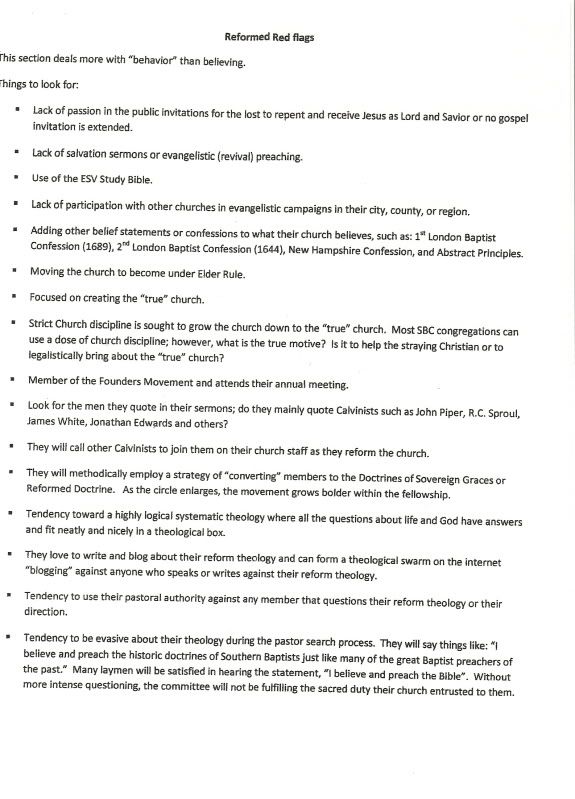
Reformed Red Flags

Over the past number of years, the Southern Baptist Church (SBC) has been fighting a battle that many evangelical churches are also fighting. The 'Calvinist vs. Arminian' debate is raging in the SBC. By the grace of God, the denomination is moving more and more towards its Reformation roots.

Recently, there has been a counter-attack rallying against the Reformed movement in the SBC . One of the tactical documents was recently given to the Founders' Ministries (one of the main agitators for reformation in the SBC). The document was for pastoral search committees to be aware of some of the 'red flags' to look out for when searching for a pastor. In the mind of many in the SBC- these are things that are to be avoided; because they are connected with Calvinism.
  • Lack of passion in public invitations for the lost to repent...
  • Use of the ESV Bible.
  • Adding... belief statements... to what their church believes... such as the First London Baptist Confession ((1689)...
  • Member of the Founders' Movement...
  • They will call Calvinists to join them on their church staff.
  • Tendency towards a highly logical systematic theology...
  • They love to write and blog about their reform theology...
I pray that the SBC continues to reform by the Grace of God in Christ. I look forward to watching the continuing unfolding of this story. And I pray that all those who love Jesus Christ will bow their knee to His Word and His Rule.

"Lord Jesus, build your Church."

26 December, 2008

2009: The Bible in One Year and Calvin's Institutes in One Year

One summer while I was in college a number of friends decided to read the Institutes together. I think that me and one young lady were the only ones to complete the work.

Since 2009 marks the 500th birthday of Calvin, I think it would be wise to read the Institutes. I am sure that a lot of people will be doing it and discussing the reading. Here is a link for how to read Calvin in a year.

And, of course, the reading of Scripture is extremely important. I always recommend the McCheyne reading plan for reading the Scriptures in one year. You have four readings a day- and at the end of the year you have read the Old Testament once, the New Testament twice, Psalms and Proverbs twice as well.

Enjoy! Let me know if you are planning on doing either!

07 November, 2008

Why Doesn't (Y)our Church Grow?

Have you ever asked the question, 'why doesn't my church grow?' I think that the experience in many Reformed churches is to find ourselves asking this question.

Have we thought that maybe we are not growing is because we are not really seeking God's Kingdom? Maybe we are too busy building our own wealth, worried too much about our 401K (or 403B in my case), our home, our seeking to entertain ourselves, our worrying more about our own families and lives than His Kingdom?

Well, someone says, Doesn't God call us to provide for our families, build wealth, rest, and take care of our spheres? Yes. We cannot deny that God calls us to these things- but they are ALL secondary to His Kingdom.

Why doesn't the Church grow? Here Pastor Quigley shows us from the book of Haggai, that the problem for many congregations is mixed loyalties. We are to seek His Kingdom FIRST! Many congregations go from Sabbath Day to Sabbath Day with no vision, no purpose for existing other than to exist. Pastor Quigley challenges the church to ask this question, "Do you YEARN for God to build His Kingdom in this place?"

30 October, 2008

Happy Reformation Day!

As Reformed Christians reflect on the goodness of God to His Church, we need to give God thanks for His provisions. On this Reformation Day we should be in meditation about the need for God to move again in a large scale, as He did during the 16th and 17th century in Europe.

During the Reformation we saw God move nations, cultures, cities, churches, families, and individuals. We need to see that movement again- and it begins with you and me. We need to be repentant, we need to seek godliness, we need to search the Scriptures.

On this Reformation Day please join me in praying that God would move us again as the Kingship of Christ is proclaimed to all nations.

As a Reformation Day gift: Here is a Reformation Study Bible in Genuine Leather being offered for any price. What better way to celebrate the Reformation than with a new Bible?

19 August, 2008

Who Is To Blame: Preacher or Pew Warmer?

Many people ask what is wrong with Reformed churches? Why are so many not growing? Why do we receive the slander of 'the frozen chosen' or 'the dead orthodox'? Truthfully, if one is chosen- he will not be frozen. There are imperatives in the Scripture that move us to be anything but frozen. And if one is orthodox, then he will not be dead, because orthodoxy requires us to have orthopraxy (right practice). Sadly, preachers want to accuse many in the pews of being the problem. We hear, 'People want to be entertained, they do not want sound preaching and demands on their lives.' Martyn Lloyd-Jones saw the problem from the other end- he blamed the preacher first; and saw the preacher's problem finding its way into the pew:

The time has come when we must assess the whole situation . It is entirely wrong to take our problems to the people; we have got to preach what is most profitable for them, what is really going to help them. The main problem of evangelicalism today (apart from slipping away from truth) is the lack of power- what do our people know of 'joy in the Holy Ghost'? You will not win people to teaching if you are a dull teacher! The wife of a deacon said to me about someone she had heard, 'He is unlike so many of our Reformed preachers who are so dull.' If you preach without moving people, you have failed as much as others. If we do not know the joy of the Lord what is the value of what we say? We must start with ourselves. To hear of 'excellent lectures on doctrine' being given on a Sunday is truly appalling. Are you right in assuming those in front of you are enjoying the Christian life, and they are able to convict others? These two things go together. Arguing about niceties will not help us. What is the value of anything if we are not living epistles?

11 August, 2008

13th Century Worship Wars

Why must we be different? It is rare today to go into a Protestant Church of any kind and find that people praise God with only their voices. The worship wars (which are officially over, according to evangelical scholars) between the organs and the praise band never took us into account. Those who praise God acapella are in the very small minority today, and were never consulted as to our thoughts on the worship wars.

So why be different? If less than 5% of the Western Church chooses to sing acapella- then what is the argument? It does not seem as though we have a leg to stand on in our argument. The Church of Jesus Christ DOES USE instruments in worship. That is just the fact.

But it was not always that way: Hear this selection from Nick Needham's (who, as far as I know, uses instruments in worship) book on Church history, 2000 Years of Christ's Power:

In the period 900-1100...organs began to become common features of the great western abbys and cathedral churches... At first the organ was used simply to give the right note for the monks and choir (like a tuning fork)... This period (900-1100) did not actually lead to a widespread use of instruments in ordinary parish churches and thus in normal Western Catholic worship. Even in the great abbeys and cathedrals the organ's use was limited... Some historical sources speak of an organ controversy in the 13th century, which resulted in the Catholic Church's declaring against the use of organs. Thomas Aquinas... confirms this, for Aquinas simply repeated the way that the early Church fathers had condemned all musical instruments in Christian worship: "The Church does not use musical instruments such as the harp and lyre when praising God, in case she should seem to fall back into Judaism..." In fact, it was not until after Aquinas in the 14th and 15th centuries, that the playing of musical instruments became a widespread, regular and accepted feature of ordinary Western worship.

So, the first 14-15 centuries of Christian worship were without instruments in worship. Then the Reformed churches abandoned them in the 16th century. That means that 3/4 of Christian history is acapella worship.

If I were in a church that used instruments, that figure alone would compel me to investigate the reason why.

17 June, 2008

The Reformed Can Jump Too!

In 2005 when Rob Bell wrote Velvet Elvis he talked about how he just wants to 'jump' and how so much of Christianity (read: Grand Rapids Reformed Christians) are not able to 'jump' but instead live in what he called 'Brick-ianity'.

When I read that 3 years ago, I thought to myself, many Reformed Christians I know enjoy a good jump. We enjoy fellowship of the saints and enjoy God and enjoy life in the Spirit. We are not all controlled by the bricks.

Today (3 years too late) I caught the perfect image of the Reformed 'loving the joys of the jump'. My children were playing on a trampoline in the front yard of Dr. Joel Beeke. They were jumping and enjoying life. They were enjoying the jump while people around enjoyed the joys of Christian community. I cannot think of anything that would better symbolize Grand Rapids Reformation Christianity than Dr. Beeke's home (and the seminary next door)! And in his front yard the future men and women of the Reformed faith are enjoying the jump!


Enjoy the jumping brothers!

11 June, 2008

The Evangelical Church is 'Rediscovering the Psalms'

As a Psalm singing Christian, it is hard to understand why anyone would want to sing anything other than the Psalms of the Bible(in the context of public worship). It is a beautiful and edifying event that promotes knowledge of Scripture, meditation on the Word, and having the very words of Christ dwell in us richly!

As someone who, in my early Christian life, did not sing Psalms exclusively, or at all, it is understandably a 'hard pill to swallow' that God wants us to sing the Psalms of the Bible as our praise and worship. It is difficult to begin as an individual, and it is difficult to begin as a congregation.

The Evangelical and Reformed Churches are rediscovering Psalmody though. Many are being converted to the practice of Psalm singing. Reformation 21 chronicled it this week, here is the sum of the whole matter:

There was a point in the history of the church when a government official--on another errand--stumbled across a long neglected book hidden in the rubble of a temple. Sure of its importance he brought it to king Josiah. The king in terror and joy read the book realizing that it was the very word of God. His response to this rediscovery was a plan of radical obedience designed to plead God's covenant mercy and praise his long forgotten redemptive works. This is what it looks like to rediscover the Bible and on a smaller scale to rediscover the psalms. It is this radically renewed worship that is spreading throughout the church today. It has deeply encouraged my soul as so many others have joined me in rediscovering the psalms.

Read the article here.

22 March, 2008

250 Years Ago Today...

Jonathan Edwards died of complications from a small pox vaccine. Edwards was a very godly Congregationalist minister that stood for the Reformed faith, for genuine revival through the Holy Spirit, opposition of the half-way covenant, and supported the humanities and the sciences. Edwards is, by far, the greatest American theologian... even though he considered himself an English subject, living in the 'plantations abroad'.

Of course, all the glory goes to God for the work done through this great father, husband, missionary, pastor, evangelist, teacher, and spiritual mentor. Praise God for building up his church!

What was Edwards' view of the Scriptures?
"Edwards' reputation as an avid student of the Bible began during his lifetime; he himself had a hand in spreading word of it. In 1757 Edwards sketched for the Trustees of the College of New Jersey several projects he hoped to publish in the future, including a ‘History of the Work of Redemption’ and a ‘Harmony of the old and new Testament.’ The former was to present a Christian theology as history in which all events in time would be considered ‘so far as the scriptures give any light.’ The latter was to deal successively with the prophecies of the Messiah, Old Testament types, and ‘the harmony of the old and new Testament.’ Of this second project, the ‘Harmony,’ Edwards wrote: ‘In the course of this work, I find there will be occasion for an explanation of a very great part of the holy scripture; which may, in such a view be explained in a method, which to me seems the most entertaining and profitable, best tending to lead the mind to a view of the true spirit, design, life, and soul of the scriptures, as well as to their proper use and improvement.’ Edwards’ untimely death a year later kept him from fulfilling these plans." -The J.E. Center, Yale University.

24 January, 2008

Missio Ecclesia

When will the church start being the church? This is a question that many in evangelical circles are asking. The context of the question is the fact that many view church as one or two services a week and then a mind-your-own-business-spirituality the rest of the week.

This was not the practice of the Lord Jesus and his disciples, the early Church, the Reformation church, the Puritans, or even Victorian Christianity. There have been great periods of the church doing ministry and living out her faith to a degree that changed lives for the sake of the Gospel. This is our duty. I think of the words of Wesley: the world is my parish! We have a duty to mankind to bring the Gospel and its life changing message. This begins in our homes, our neighborhoods, our communities, and extends to all spheres of life with which we have contact. Most importantly, this is done in Word and in deed.

1 John 3:18 My little children, let us not love in word, neither in tongue; but in deed and in truth. Colossians 3:17 And whatsoever ye do in word or deed, do all in the name of the Lord Jesus, giving thanks to God and the Father by him.

The Lord has been showing me this more and more and I know that there are many saints in the Reformed churches that are seeing the need for Jesus Christ to break into our lives and to make a people that are more than 'Sunday Christians'. It is sad to see the Emergent Church and the Evangelicals doing more- and with less Truth. There is much work to do. The Lord Jesus said,

Matthew 9:37-38 The harvest truly is plenteous, but the labourers are few; Pray ye therefore the Lord of the harvest, that he will send forth labourers into his harvest.

He also said concerning those who claimed to be Christians, but did not do these works that the Gospel requires of them:

Matthew 25:42-46 For I was an hungred, and ye gave me no meat: I was thirsty, and ye gave me no drink: I was a stranger, and ye took me not in: naked, and ye clothed me not: sick, and in prison, and ye visited me not. Then shall they also answer him, saying, Lord, when saw we thee an hungered, or athirst, or a stranger, or naked, or sick, or in prison, and did not minister unto thee? Then shall he answer them, saying, Verily I say unto you, Inasmuch as ye did it not to one of the least of these, ye did it not to me. And these shall go away into everlasting punishment: but the righteous into life eternal.

We have much to reform in the Reformed churches; much of which does have to do with doctrine, but with practice. Our heritage is filled with men and women who lived for the sake of advancing the Gospel; many of us are but consumers. My pastor has challenged his congregation with this.

What should be done from? Should we continue with individualistic consumerism, or be the Church?

14 January, 2008

Who Would Luther Read?

‘Bernard of Clairvaux, a man so godly, so holy, so pure, that we should commend and prefer him before all the theologians of the Church.”

14 December, 2007

The Sufficiency of Scripture in Sola Scriptura

I have finished a paper that I have been working on for 4 months on the doctrine of Sola Scriptura. This doctrine is abused in many ways, and has been since the time of the Reformation when the doctrine was fully developed (I say 'fully' because the doctrine is in the Scriptures as early as the Torah.). There are three ways that it is historically abused:
  • A doctrine cannot be required to be believed that is not EXPLICITLY found in Scripture.
  • Nothing can be done without the warrant of Scripture. (We can't sit in chairs during worship- where is that in the Bible?)
  • Traditions and Creeds of the Church are not important because the Bible is all that matters.
This third abuse is discussed by Allister McGrath and he does a good job of showing that sola scriptura does not negate our traditions, as long as they are supported by the Word of God.

“A number of points bring out the importance of the sola scriptura principle. First, the Reformers insisted that the authority of the popes, counsels, and theologians is subordinate to that of Scripture. This is not necessarily to say that they have no authority… the Reformers allowed certain councils and theologians of the patristic era genuine authority in matters of doctrine. It is to say however, that such authority is derived from Scripture, and is thus subordinate to Scripture. Luther tends to defend the sola scriptura principle by emphasizing the confusion and incoherence of medieval theology, whereas Calvin and Melanchthon argue that the best catholic theology supports their view on the priority of Scripture.”

Allister E. McGrath, Reformation Thought, (Grand Rapids: Baker, 1994), 145.

15 November, 2007

Comfort For His People

I am doing a comparison on a number of Reformed Creeds as part of my course-work this semester. I have regained a love and appreciation for the Belgic Confession of Faith. It is so experiential, practical, applicable, and comforting to the Christian. The article on the Sacraments is just one example of the many fine articles that our Continental brethren hold so dear:

We believe that our gracious God, taking account of our weakness and infirmities, has ordained the sacraments for us, thereby to seal unto us His promises, and to be pledges of the good will and grace of God towards us, and also to nourish and strengthen our faith; which He has joined to the Word of the gospel, the better to present to our senses both that which He declares to us by His Word and that which He works inwardly in our hearts, thereby confirming in us the salvation which He imparts to us. For they are visible signs and seals of an inward and invisible thing, by means whereof God works in us by the power of the Holy Spirit. Therefore the signs are not empty or meaningless, so as to deceive us. For Jesus Christ is the true object presented by them, without whom they would be of no moment. Moreover, we are satisfied with the number of sacraments which Christ our Lord has instituted, which are two only, namely, the sacrament of baptism and the holy supper of our Lord Jesus Christ -Belgic Confession, Article XXXII

05 November, 2007

A Faithful Martyr Of Jesus Christ

While discussing the life and death of Guido De Bres, it was brought to my attention that there are a few of his letters that have not been translated from Dutch to English.

His letter to his wife prior to his beheading is so loving and passionate. It clearly shows that a man that loves the Lord Jesus Christ above all will show love to his wife in all circumstances- even the death of martyrdom. Let us follow in faithfulness to Jesus Christ and love for Him. May God grant some of us the great honor of dying as a faithful martyr to Jesus Christ.

I am practicing now what I have preached to others. And I must confess that when I preached I would speak about the things I am actually experiencing as a blind man speaks of colour. Since I was taken prisoner I have profited more and learned more than during all the rest of my life. I am in a good school: the Holy Spirit inspires me continually and teaches me how to use the weapons in this combat. On the other side is Satan, the adversary of all children of God. He seeks to wound me. But he who has said, “Fear not, for I have overcome the world,” makes me victorious. And already I see that the Lord puts Satan under my feet and I feel the power of God in my weakness....

As you have always loved me, I pray that you will continue this love toward our children, instructing them in the knowledge of the true God and of his Son Jesus Christ. Be their father and their mother, and take care that they use honestly the little that God has given you. If God does you the favour to permit you to live in widowhood with our children after my death, that will be well. If you cannot, and the means are lacking, then go to some good man, faithful and fearing God. And when I can, I shall write to our friends to watch over you. I think that they will not let you want for anything. Take up your regular routine after the Lord has taken me. You have our daughter Sarah who will soon be grown. She will be your companion and help you in your troubles. She will console you in your tribulations and the Lord will always be with you. Greet our good friends in my name, and let them pray to God for me, that he may give me strength and the wisdom and ability to uphold the truth of the Son of God to the last breath of my life.


The letter is quite inspiring as well as convicting. It can be read here.