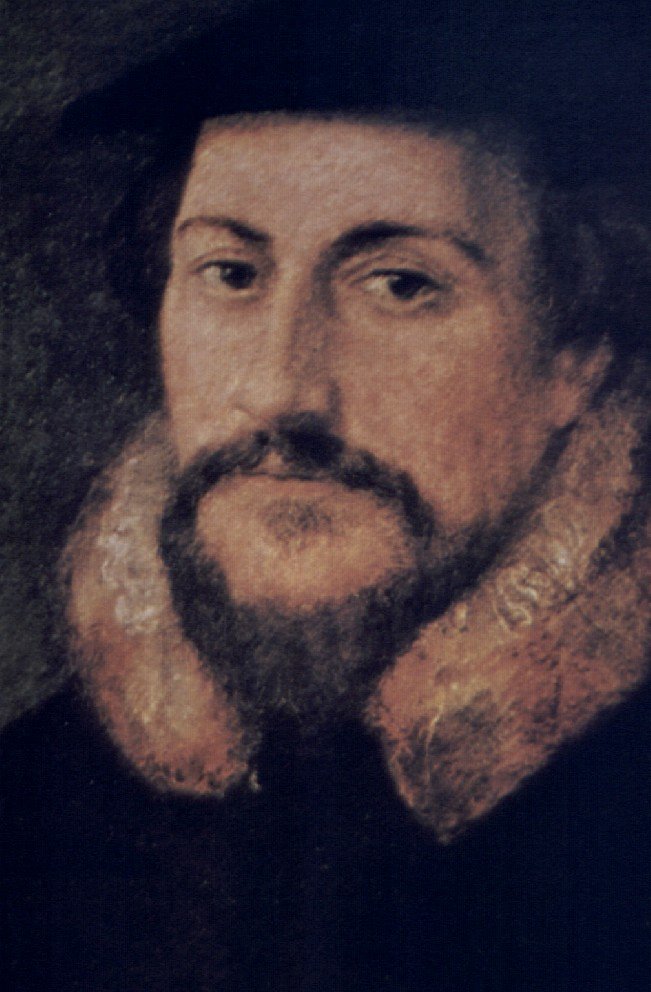
08 December, 2005

Christ as Savior, Christ as Judge

All men will have to reckon with the Lord Jesus Christ. All men will have to one day declare that Jesus Christ is the Lord. Some will bow willfully in this life, humiliating themselves before their only hope for salvation. Other men, also willful, will have to bow on bloody knees. They will have to bow to the Lord Jesus Christ after having been forced to declare his Lordship. All will declare that Christ is the Lord.

This is a very sobering thought for us as Christians, and one that should give us much evangelical zeal. Every Christian has a responsibility to present the Lord is all three of his offices:
1. Christ the Prophet
2. Christ the Priest
3. Christ the King.

One day he will return and we will have to give account for all that we have done in the flesh. It is my prayer that he says, "well done good and faithful servant." "Since then the gospel invites all to partake of salvation without any difference, it is rightly called the doctrine of salvation: for Christ is there offered, whose peculiar office is to save that which was lost; and those who refuse to be saved by him, shall find him a Judge."

John Calvin, Commentary on Romans 1:16.


Discussion Points:
-How are the three offices of Christ to be used in evangelism?
-Does the Christian have his sins revealed at judgment day?
-Why are the Reformed accused of not having "missionary hearts" when they have done more for missions than any other sector of Christianity?

06 December, 2005

Tis the Season II: Evangelicals Trump God

Christmass falls on a Sunday this year. Christians have always seen Sunday as a holy day, a holiday. It is called the Lord's Day or the Christian Sabbath. This day (Sunday) has historically been used by Christians to worship God- meeting twice to worship, praying with family, having bible studies, fellowshipping with the people of God, and "sanctifying the day as unto the Lord".

Christians have historically seen the Sabbath as a day that is a creational ordinance. In creation a day of rest was established, this is not rooted in the Mosaic law, it has been part of the true religion since the onset of time. All men are to set aside this day to glorify and to enjoy God.

With that in mind, read the second article in my "Tis the Season" series: AP-Lexington, KY, December 5, 2005, 3:41 p.m. Central Kentucky's largest church will be shuttered and dark on Christmas Sunday, a move drawing some criticism among the faithful.
Southland Christian Church near Lexington is joining several evangelical megachurches across the country in canceling services for the holiday. Officials at the church, where about 7,000 people worship each week, said the move is designed to allow staff and volunteers to spend the holy holiday with their families.
The megachurches, which rank among the largest congregations in America, will hold multiple Christmas Eve services instead.
Among the churches closed on Christmas Sunday are Willow Creek Community Church, the Chicago area's largest congregation; Mars Hill Bible Church in Grandville, Michigan; North Point Community Church in Alpharetta, Georgia; and Fellowship Church near Dallas.
Megachurch officials around the country consulted with each other before deciding to take the day off.
"It's more than being family friendly. It's being lifestyle-friendly for people who are just very, very busy," said Willow Creek spokeswoman Cally Parkinson.
The move is drawing mixed reviews. Critics say it's the day of the week -- not the day of the year -- that's sacred. To them, closing the doors of the church on the Lord's Day is unthinkable.
Others are troubled by the holiday's increasingly secular tone and lament the change.
Robert K. Johnston, a professor of theology and culture at Fuller Theological Seminary in Pasadena, California, worries that another Christian tradition is fading.
"What's going on here is a redefinition of Christmas as a time of family celebration rather than as a time of the community faithful celebrating the birth of the savior," Johnston said.
"There is a risk that we will lose one more of our Christian rituals, one that's at the heart of our faith."
The decision hasn't generated much controversy at Southland, said church spokeswoman Cindy Willison.
"We've probably had maybe half a dozen (complaints), which is understandable," Willison said.
Some churches are scaling down their Sunday schedule on Christmas.
Louisville's Southeast Christian Church, where 18,000 people worship each weekend, is scheduled to hold one service on Christmas in the fellowship hall.
Tom Shaughnessy, a spokesman for the Roman Catholic Diocese of Lexington, said churches will be open because it is a holy day of obligation for Catholics, meaning attendance at Mass is required.
At least one other major Lexington congregation, Crossroads Christian Church, will close for Christmas.
Crossroads Pastor Glenn Schneiders says December 25 is no longer considered sacred by many Americans -- especially those who are not regular churchgoers.
"It's viewed more as a holiday than a holy day," he said.
Lexington Theological Seminary professor Bill Turner said some congregations find it tough to hold several Christmas Eve services, then turn around for Christmas Day services.
"You're talking about a lot of volunteers and a lot of logistics to make Sunday happen in a lot of those megachurches," he said.
At First United Methodist Church in Lexington, the pastor will perform a "blessing of the toys," and the congregation will sing Christmas carols, church spokeswoman Marsha Berry said.
"Even if there's a small group, we'll be there to worship," she said. "What better day than Christmas to experience God?"
(Copyright 2005 by The Associated Press. All Rights Reserved.)

05 December, 2005

The Great Disappointment

In today's popular Christianity there has not been a more lucrative business to be in than in end times prophecy. Americans are obsessed with this a point that is out of control. Little do American Christians know concerning the history behind chiliasm or premillennialism.

Granted, there are a handful of church fathers that believed in this doctrine, but it was in the minority even then. It was not revived in the church again until the Anabaptists of the time of the reformation. (Those who held to the view were lawless in those days and their stories would make a great essay for future blogging.) When this view became popular as a whole, was through the father of dispensationalism, Darby, and popularized in the CI Scofield reference bible.

Premillennialism has a played a very minor role in the Christian church, and most theologians that hold to this view find themselves in the business of predicting the time of the second coming. (Against the words of Christ who said, "no man knoweth the day nor the hour."
AA Hodge, Outlines of Theology:

What are the principal Scriptural arguments against the pre-millennial view?

1st.The theory is evidently Jewish in its origin and Judaizing in its tendency.

2nd. It is not consistent with what the Scriptures teach. (1) As to the nature of Christ's kingdom, e.g., (a) that it is not of this world but spiritual, Matthew 13:44; John 18:36; Romans 14:17; (b) that it was not to be confined to the Jews Matthew 8:11, 12; (c) that regeneration is the condition of admission to it, John 3:3, 5; (d) that the blessings of the kingdom are purely spiritual, as pardon, sanctification, etc., Matthew 3:2, 11; Colossians 1:13, 14. (2) As to the fact that the kingdom of Christ has already come. He has sat upon the throne of his Father David ever since his ascension.Acts 2:29-36; 3:13-15; 4:26-28; 5:29-31; Hebrews 10:12, 13; Revelation 3:7-12. The Old Testament prophecies, therefore, which predict this kingdom, must refer to the present dispensation of grace, and not to a future reign of Christ on earth in person among men in the flesh.

3rd. The second advent is not to occur until the resurrection, when all the dead, both good and bad, are to rise at once. Daniel 12:2; John 5:28, 29; 1 Corinthians 15:23; 1 Thessalonians 4:16; Revelation 20:11, 15. Only one passage (Revelation 20:1-10) is even apparently inconsistent with the fact here asserted. For the true interpretation of that passage, see next question.

4th.The second advent is not to occur until the simultaneous judgment of all men, the good and the bad together. Matthew 7:21, 23; 13:30-43; 16:24, 27; 25:31-46; Romans 2:5, 16; 1 Corinthians 3:12-15; 2 Corinthians 5:9-11; 2 Thessalonians 1:6-10; Revelation 20:11-15.

5th.The second advent is to be attended with the general conflagration and the generation of the "new heavens and the new earth."2 Peter 3:7-13; Revelation 20:11; 21:1. "Brown on the Second Advent."


Discussion Points:
-What role does eschatology play in the practical life of the believer?
-Explain the saying, All of life is eschatological?
-What should be the punishmentpredictingwrongly prediciting dates for the second coming? (Ecclesiastical and Magisterial)

01 December, 2005

The Humility to Worship

Worship has been the topic of the week here on PRESBYTERIAN THOUGHTS. When this much meditation on the subject occurs, we should enter our houses of worship on the Sabbath day in awe of a great and glorious God. This great God, who is jealous for his worship, has given us his Son as the mediator of all worship that is brought to his throne.

We need to come before God with humility as we storm the throne room of Grace for the answers that we seek. Let us be as the prophet Isaiah and come with the understanding that we are men and women of unclean lips.

Touch thou our lips that we may be cleansed to worship thee as we ought.


The Westminster Confession of Faith, chapter xxi, Of Worship:

I. The light of nature showeth that there is a God, who hath lordship and sovereignty over all, is good, and doth good unto all, and is therefore to be feared, loved, praised, called upon, trusted in, and served, with all the heart, and with all the soul, and with all the might.[1] But the acceptable way of worshiping the true God is instituted by himself, and so limited by his own revealed will, that he may not be worshiped according to the imaginations and devices of men, or the suggestions of Satan, under any visible representation, or any other way not prescribed in the Holy Scripture.[2]
1. Rom. 1:20; Psa. 19:1-4a; 50:6; 86:8-10; 89:5-7; 95:1-6; 97:6; 104:1-35; 145:9-12; Acts 14:17; Deut. 6:4-52. Deut. 4:15-20; 12:32; Matt. 4:9-10; 15:9; Acts 17:23-25; Exod. 20:4-6, John 4:23-24; Col. 2:18-23

II. Religious worship is to be given to God, the Father, Son, and Holy Ghost; and to him alone; [3] not to angels, saints, or any other creature:[4] and, since the fall, not without a Mediator; nor in the mediation of any other but of Christ alone.[5]
3. John 5:23; Matt. 28:19; II Cor. 13:14; Eph. 3:14; Rev. 5:11-14; Acts 10:25-264. Col. 2:18; Rev. 19:10; Rom. 1:255. John 14:6; I Tim. 2:5; Eph. 2:18; Col. 3:17

III. Prayer, with thanksgiving, being one special part of religious worship,[6] is by God required of all men:[7] and, that it may be accepted, it is to be made in the name of the Son,[8] by the help of his Spirit,[9] according to his will,[10] with understanding, reverence, humility, fervency, faith, love, and perseverance;[11] and, if vocal, in a known tongue.[12]
6. Phil. 4:6; I Tim. 2:1; Col. 4:27. Psa. 65:2; 67:3; 96:7-8; 148:11-13; Isa. 55:6-78. John 14:13-14; I Peter 2:59. Rom. 8:26; Eph. 6:1810. I John 5:1411. Psa. 47:7; Eccl. 5:1-2; Heb. 12:28; Gen. 18:27; James 1:6-7; 5:16; Mark 11:24; Matt. 6:12, 14-15; Col. 4:2; Eph. 6:1812. I Cor. 14:14

IV. Prayer is to be made for things lawful;[13] and for all sorts of men living, or that shall live hereafter:[14] but not for the dead,[15] nor for those of whom it may be known that they have sinned the sin unto death.[16]
13. I John 5:14, 16; John 15:714. I Tim. 2:1-2; John 17:20; II Sam. 7:29; II Chr. 6:14-4215. Luke 16:25-26; Isa. 57:1-2; Psa. 73:24; II Cor. 5:8, 10; Phil 1:21-24; Rev. 14:13
16. I John 5:16

V. The reading of the Scriptures with godly fear,[17] the sound preaching [18] and conscionable hearing of the Word, in obedience unto God, with understanding, faith, and reverence,[19] singing of psalms with grace in the heart;[20] as also, the due administration and worthy receiving of the sacraments instituted by Christ, are all parts of the ordinary religious worship of God:[21] beside religious oaths,[22] vows,[23] solemn fastings,[24] and thanksgivings upon special occasions,[25] which are, in their several times and seasons, to be used in an holy and religious manner.[26]
17. Luke 4:16-17; Acts 15:21; Col. 4:16; I Thess. 5:27; Rev. 1:318. II Tim. 4:2; Acts 5:4219. James 1:22; Acts 10:33; Matt. 13:19; Heb. 4:2; Isa. 66:220. Col. 3:16; Eph. 5:19; James 5:13; I Cor. 14:15
21. Matt. 28:19; I Cor. 11:23-29; Acts 2:4222. Deut. 6:13; Neh. 10:29; II Cor. 1:2323. Psa. 116:14; Isa. 19:21; Eccl. 5:4-524. Joel 2:12; Est. 4:16; Matt. 9:15; Acts 14:2325. Exod. 15:1-21; Psa. 107:1-43; Neh. 12:27-43; Est. 9:20-2226. Heb. 12:28.

VI. Neither prayer, nor any other part of religious worship, is now, under the gospel, either tied unto, or made more acceptable by any place in which it is performed, or towards which it is directed:[27] but God is to be worshiped everywhere,[28] in spirit and truth;[29] as, in private families [30] daily,[31] and in secret, each one by himself;[32] so, more solemnly in the public assemblies, which are not carelessly or willfully to be neglected, or forsaken, when God, by his Word or providence, calleth thereunto.[33]
27. John 4:2128. Mal. 1:11; I Tim. 2:829. John 4:23-2430. Jer. 10:25; Deut. 6:6-7; Job 1:5; II Sam. 6:18, 2031. Matt. 6:11; see Job 1:532. Matt. 6:6; 16-18; Neh. 1:4-11; Dan. 9:3-4a33. Isa. 56:6-7; Heb. 10:25; Psa. 84:1-12; 100:4; 122:1, Luke 4:16; Acts 2:42; 13:42, 44

VII. As it is the law of nature, that, in general, a due proportion of time be set apart for the worship of God; so, in his Word, by a positive, moral, and perpetual commandment binding all men in all ages, he hath particularly appointed one day in seven, for a Sabbath, to be kept holy unto him:[34] which, from the beginning of the world to the resurrection of Christ, was the last day of the week,[35] and, from the resurrection of Christ, was changed into the first day of the week, which, in Scripture, is called the Lord's day,[36] and is to be continued to the end of the world, as the Christian Sabbath.[37]
34. Exod. 20:8-11; Isa. 56:2- 735. Gen. 2:2-3; I Cor. 16:1-2; Acts 20:736. Rev. 1:1037. Matt. 5:17-18; Mark 2:27-28; Rom. 13:8-10; James 2:8-12

VIII. This Sabbath is then kept holy unto the Lord, when men, after a due preparing of their hearts, and ordering of their common affairs beforehand, do not only observe an holy rest, all the day, from their own works, words, and thoughts about their worldly employments and recreations,[38] but also are taken up, the whole time, in the public and private exercises of his worship, and in the duties of necessity and mercy.[39]
38. Exod. 16:23, 25-26, 29-30; 20:8; 31:15-17; Isa. 58:13-14; Neh. 13:15-2239. Isa. 58:13-14; Luke 4:16; Matt. 12:1-13; Mark 3:1-5


Discussion Points:
-What can Westminster teach us concerning worship?
-Is this view of worship too constricting to Christian liberty?
-What are some biblical examples of men and women not worshipping according to the Bible's principle of worship?

Contemporary Christian Music

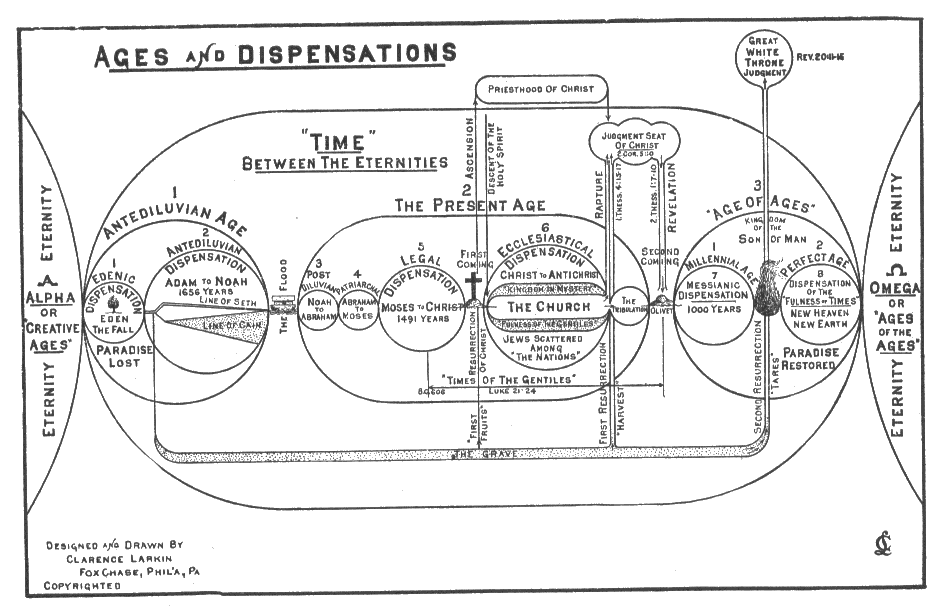
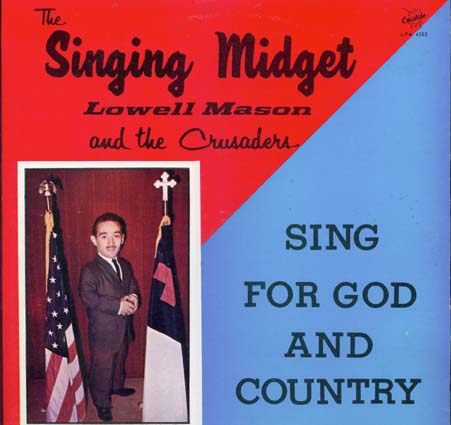
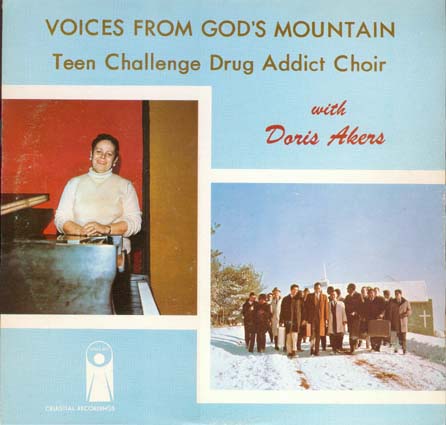
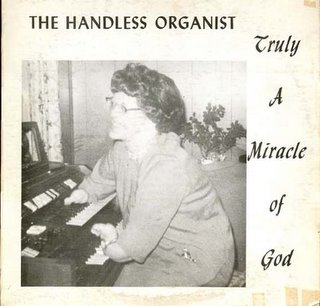
Since someone commented on this blog criticizing the choice of music that old school Presbyterians use in worship, I thought that it would be appropriate to show my readers the kinds of music that CCM is putting out today.

Many young Christians are into very worldly music and attempt to reason it away using Kuyperian principles that they learned while attending Calvin College. Friends and dear readers, music is very sacred.

My children will not listen to the current rock and roll type music that calls itself Christian. Let us look at some of the covers of those CDs that all the kids are into and attempting to get their God fearing parents to spend their hard earned money on:


These should speak for themselves! Feel free to comment.

29 November, 2005

No Need For Organ Donation

For those of you interested in the topic, one of my yahoo groups (r-f-w) has been discussing the use of musical instruments in the public worship of God.
I have included a few links that have come up during the course of the discussion. They are worth looking into for those interested in the topic of worship.
GI Williamson and others on Instrumental Music http://members.aol.com/rsichurch/worship.html

John Kennedy on Instrumental Music
http://easyweb.easynet.co.uk/~jbeggsoc/jbs-worship02.html

John M'Donald on Instrumental Music
http://www.fpcr.org/blue_banner_articles/mdonald.htm

Brian Schwertley on Musical Instrumentation
http://www.reformed.com/pub/music.htm

Blood Covered Coloring Pages

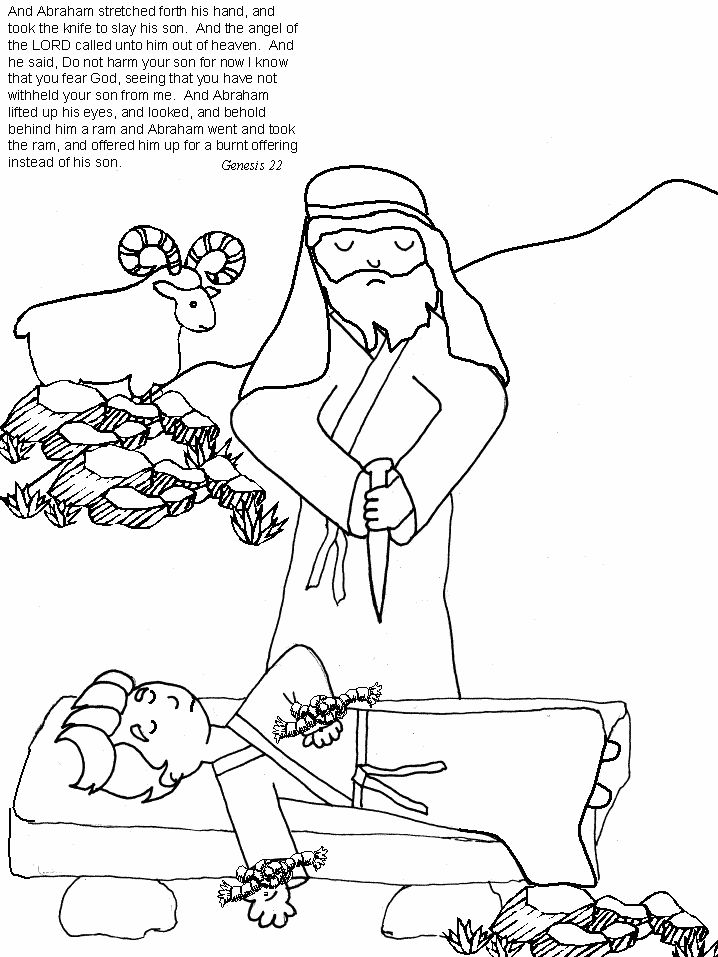
This is a copy of my daughter's coloring page from her Sabbath school class (she is two years old). Notice that Presbyterians of the historical kind do not bow the knee to political correctness.
We are to teach the whole counsel of God, and sometimes those truths are not very fun to share. But they are a part of the Gospel. In Genesis 22 we have Abraham going to sacrifice his son to God. God provided a scapegoat in the thicket as a type of the coming Messiah.
Praise God that He provided a scapegoat in His son Jesus Christ. May we glean truth from forbidden coloring pages that liberal Christians do not want us to share in our churches or in our homes with our children.

Discussion Point:
-Share one of your favorite forbidden Bible stories.

25 November, 2005

Tis the Season I: It's beginning to look a lot like Christmass

I love Christmass as much as the next paleo-Presbyterian.
It looks like the holy day spirit is upon us. Is the Lord pleased?


From Wood TV8:(Cascade Township, November 25, 2005, 12:20 p.m.) It was a dangerous morning on Black Friday at a West Michigan Wal-Mart.
An impatient crowd stormed the doors in the mad rush to get to those door-buster deals inside.
It was an ugly scene when the doors opened at the Cascade Township Wal-Mart. Hundreds of shoppers pushed and shoved their way into the store, trampling a number of customers, sending two to the hospital.
At 5:00 a.m. the doors opened, holiday shoppers rushed in, and immediately one customer is pushed to the ground.
"This is ridiculous. I do not want my life in danger for this," said shopper Karen Dietstra. "This is not worth it. This has been a tradition for years. I don't think that I have to get beat up to try to get a sale."
Two shoppers from Grand Rapids did. One of them, 13-year-old Deja McHerron, had to be taken away by ambulance.
"They stumbled over a pregnant lady and Deja was trying to help her get up. And they stumbled over her and they stepped on her back. And now she's going to the hospital," said McHerron's mother, Deborah.
Duretha Arnold-Youngblood, 37, was also taken to the hospital, complaining of an injured knee. Her husband, Johnny Youngblood, took issue with what he calls a lack of security. Youngblood believes Wal-Mart should hire trained uniformed security guards to help bring order to the early-morning holiday crowd and not leave those duties to Wal-Mart associates.
"They didn't have no security at all," said McHerron's sister, Sierra.
"Wal-Mart did not do enough to protect us," Dietstra said.
What went wrong? Managers at the Cascade Wal-Mart are not commenting at this time.

Hope For the Immature in Faith

Many Christians are very immature in their faith. They understand that the they are to grow in their love for the Lord Jesus and the seek to do so by attending the means of grace. They read, pray, listen to sermons, attend church, even the Lord's Supper, but something remains missing in their Christian experience. Without being able to verbalize the problem, many Christians in today's entertainment culture are looking for just that: entertainment.

Even in the most conservative of Reformed and Presbyterian churches you have this problem of entertainment. In these circles this sin will manifest itself in the immature Christian as always needing to chase after a new doctrine or base the "value" of a sermon on whether or not he or she has heard something new. This attitude can be harmful to the Church of Christ. God has chosen to have his people follow the Old Paths...he does not call us to chase after and blaze new ones.

Charles Bridges, in his early 1800s volume to Christian ministers addressed the need for novelty:
The first impressions (of the faith) may have been made rather by the novelty than by the direct power of truth....to live up to the continual excitement of novelty, in preference to the old established truths. This naturally results in an imperfect* apprehension of the Gospel, that fully accounts for defects of Christian temper, as well as for the unsteady resistance to the world...favouratism (sic) in Scripture is both the grandparent of heresy and instability of profession. The Word of God loses its power when displaced from its position, dissevered from its practical connexion (sic), or when a part, however important, is taken for the whole...

*imperfect as in not whole, or not complete.

Bridges sees these people as needing to be novel in faith which leads to a favoratism of certain passages of the bible (examples: John 3.16, I Cor 12 or 13, or Biblical sayings "Judge not", "All in moderation", etc.) which will in turn lead to many types of heresy and discontentment in their faith. The anedote to the problem he also gives: prefer the old established truths. This is the calling of all Christians, immature and well seasoned, do not forsake the old paths for the need to be novel and entertained.

Discussion Points:
-How can we encourage the immature in faith?
-What personal disciplines will aid in fighting the need to be entertained (however subtle the need is?)
-What spiritual excercises would you recommed for those struggling against this serious sin?

23 November, 2005

God loves a few Prelates

Jokingly my wife has said to me that the two greatest influences in her life have been a Baptist (Spurgeon) and a Prelate (Ryle). They are both fantastic preachers despite their views on church government, the millennium, and baptism.

I too love Ryle and Spurgeon. May it be duly noted for the sake of my ecumenical spirit.

The latter end of the nineteenth century was a time when preaching was still fantastic in England, but Confessionalism was not. Below is a quote from Ryle on the exalted state of preaching. Any comments?

"A preaching ministry is absolutely essential to the health and prosperity of a visible church. The pulpit is the place where the chief victories of the Gospel have always been won, and no Church has ever done much for the advancement of true religion in which the pulpit has been neglected. Would we know whether a minister is a truly apostolical man? If he is, he will give the best of his attention to his sermons. The minister who exalts the sacraments, or forms of the church, above preaching, may be a zealous earnest, conscientious, and respectable minister, but his zeal is not according to knowledge."

17 November, 2005

The Future Glory of The Church

There are many Christians today who stand discouraged at the state of the Church and the lack of care (and hostility) for Christianity in our culture. We should commend those that love the Church and long for her purity as she awaits Her bridegroom. Even in the days of the Reformers and the Puritans there were those that saw a cultural disregard for the True Religion. The Church ebbs and flows through history and we must patiently await the day when all peoples and nations will humbly bow to Christ in His law, His gospel, and His will. Until this time, let us turn to Jonathan Edwards' Humble Attempt for comfort and direction. Thy Kingdom Come.
IT is evident from the Scripture, that there is yet remaining a great advancement of the interest of religion and the kingdom of Christ in this world, by an abundant outpouring of the Spirit of God, far greater and more extensive than ever yet has been. It is certain, that many things, which are spoken concerning a glorious time of the church's enlargement and prosperity in the latter days, have never yet been fulfilled. There has never yet been any propagation and prevalence of religion, in any wise, of that extent and universality which the prophecies represent. It is often foretold and signified, in a great variety of strong expressions, that there should a time come, when all nations, throughout the whole habitable world, should embrace the true religion, and be brought into the church of God. It was often promised to the patriarchs, that "in their seed all the nations, or (as it is sometimes expressed) all the families of the earth shall be blessed." Agreeably to this, it is said of the Messiah, Psalm 72:11. "That all nations shall serve him," and in verse 17. "Men shall be blessed in him, and all nations shall call him blessed." And in Isaiah 2:2. It is said, that "all nations shall flow unto the mountain of the house of the Lord." And Jeremiah 3:17. "That all nations shall be gathered unto the name of the Lord to Jerusalem, and shall walk no more after the imagination of their evil heart. "That all flesh shall come and worship before the Lord," Isaiah 66:23. "And that all flesh should see the glory of God together," Isaiah 40:5. "And that all flesh should come to him that hears prayer," Psalm 65:2.

Discussion Points:
-What passages should we pray back to God for the coming of his kingdom?
-What comfort is there in this section of eschatology for the believer?
-What does "thy kingdom come" mean in your own words?

15 November, 2005

Refobar (Pronounced Ray-Fo-Bar)

I am taking a Youth Ministry course at the Puritan Reformed Seminary and a minister from the Heritage Reformed Churches is teaching. We have been discussing some of the things that youth groups do that are very far from being glorifying to God and how we want to avoid this as Reformed Christians. We have discussed things such as how all of our ministering needs to be done with the glory of God in mind and how we must keep our theological presuppositions in the forefront of our ministry.

One thing that he (Rev. Kelderman) mentioned that is being done in the Netherlands (and also in Canada) is what is known as the Refobar. Of course I had no idea what he was talking about but he explained:

The Refobar (Slang for Reformed Bar) is when churches host underage drinking parties in their basement knowing that it will attract the youth and they will have the opportunity to minister to them.

Why can't the Presbyterians be so creative?

Hey, Young People's Society.....Scotch anyone?

13 November, 2005

The ARC of Grand Rapids

A new Presbyterian Thoughts link:


The Associate Reformed Church website is finally open. The go-live date was May 15, 2005. Congratulations to the ARC!

www.arcgr.org

Thanks James Lanning of "Set It Off" for making this possible.

12 November, 2005

Save Your Question For the Old Oak Tree


Charles Haddon Spurgeon has been called the "prince of preachers". His sermons are excellent, three dimensional, and full of life. Spurgeon, as a Minister of the Gospel and a teacher at a Pastor's College, was also a mentor to many men who were pursuing a greater understanding of their relationship with Jesus Christ as they pursued the ministry.

His students would gather under a giant old oak tree for theological questions, to challenge one another, and to edify one another. The great tree became known to Spurgeon's students as "The Question Oak". This is where they would bring theological questions to their teacher. The Question Oak is the location where this event took place:

It has been said that every Friday afternoon, his students were usually asked to exhibit there own ability as preachers and that without prior knowledge of the subject matter. Spurgeon called upon a student to give a message on Zaccheus. The student arose and said:

"Zaccheus was little of stature, so am I. Zaccheus was up a tree, so am I. Zaccheus came down, so will I." The students, as well as Pastor Spurgeon, applauded the "ingenious" performance.

Discussion Points:

-What place has been important for you for theological discussion in your Christian walk?

-Often the people of God will come into great comfort by meeting up with another Christian in an obscure/unusual place. Have you had this edifying experience?

-What could we do, as Christians, to encourage more theological discussion in "open air areas"?

09 November, 2005

Reformed Lip Service

I would like to offer you a quote that I read this week. It caused many thoughts to go racing through my theological mind and I began to take inventory of my own heart. I hope that it will impact you or at least give you a rumination towards reform.
"Isn't it interesting how professing Christians love to honor the dead heroes of the faith, but then "persecute" the living heroes who embrace the very same truths taught and propounded by those heroes who are now in the grave.

Why?

Because dead heroes can no longer speak with audible voices against unsound doctrine, impure worship, and tyrannical church governments."

Discussion Points:

-What are some biblical examples of reform that can be used to humble ourselves and return to the "old paths"?

-Should denominations put weight into the way in which our forefathers interpreted scriptures if they are different than our interpretations?

-How has this played out in the church historically, confessionally, and experientially?

06 November, 2005

On Hating Sin and Hating Sinners

While discussing the idea of the heinousness of sin, the Westminster Divines understood that not all sin is seen as being equal in the sight of God. While all sin deserves eternal damnation in hell; not all are equally repulsive in God's sight.

When asking modern evangelicals about God's view of sin, besides the notable, "God hates the sin and not the sinner," it is interesting to note that lifestyle choices are often seen as the most heinous of sin. Homosexuality and drunkenness are often cited as being most despicable in the eyes of God.

Scripture has another idea. Notice questions 150 and 151 of the Westminster Larger Catechism show that the sins that are most heinous in the sight of God are those that go against His Word, His Son, and His worship.

This is not how we are taught to think, even in our self-centered American evangelical minds. God is a jealous God for His worship...His name IS jealous.


Q. 150. Are all transgressions of the law of God equally heinous in themselves, and in the sight of God?
A. All transgressions of the law of God are not equally heinous; but some sins in themselves, and by reason of several aggravations, are more heinous in the sight of God than others.

Q. 151. What are those aggravations that make some sins more heinous than others?
A. Sins receive their aggravations,
1. From the persons offending if they be of riper age, greater experience or grace, eminent for profession, gifts, place, office, guides to others, and whose example is likely to be followed by others.
2. From the parties offended:if immediately against God, his attributes, and worship; against Christ, and his grace; the Holy Spirit, his witness,and workings against superiors, men of eminency, and such as we stand especially related and engaged unto; against any of the saints, particularly weak brethren the souls of them, or any other,and the common good of all or many.
3. From the nature and quality of the offense: if it be against the express letter of the law, break many commandments, contain in it many sins: if not only conceived in the heart, but breaks forth in words and actions, scandalize others, and admit of no reparation: if against means, mercies, judgments, light of nature, conviction of conscience, public or private admonition, censures of the church, civil punishments; and our prayers, purposes, promises, vows, covenants, and engagements to God or men: if done deliberately, wilfully, presumptuously, impudently, boastingly, maliciously, frequently, obstinately, with delight, continuance, or relapsing after repentance.
4. From circumstances of time and place: if on the LordÂ’s day, or other times of divine worship; or immediately before or after these, or other helps to prevent or remedy such miscarriage if in public, or in the presence of others, who are thereby likely to be provoked or defiled.

Discussion Points:
-If Dispensationalists were right on the negation of the law, then by what standard are we to judge the lawfulness of an act?
-What are some biblical examples of God's punishment for false worship?
-By what standard do "New Testament" Christians worship? What does worship look like and contain?

Puritan Resource Center


Here is an article that was in the Religion section of the Grand Rapids Press on October 29th concerning the Puritan Resource center at the Puritan Reformed Theological Seminary:

GRAND RAPIDS -- Believing the 17th-century Puritans have much to say to today's Christians, the Puritan Reformed Theological Seminary has opened one of the world's largest collections of books by and about Puritans.

Hundreds of rare, antiquarian books line the shelves of a room off the library in the small seminary at 2965 Leonard St. NE. Some books date to the early 1600s. Some were never reprinted, and only a few copies exist. "The strength of this library is all of the antiquarian books," said seminary President Joel Beeke, who collected most of the books, starting when he was 14 years old. He expects researchers from around the world to take advantage of the center, dedicated Oct. 20. About 2,500 volumes in all, with another 500 coming soon, surround one of the centerpieces of the valuable collection -- three rebound volumes of "The Works of William Perkins" from 1612 to 1613, one of a couple hundred sets in the world and once owned by famous 19th-century England preacher Charles Spurgeon.
Perkins is considered one of the fathers of Puritanism, a movement that began in the late 16th century to apply the philosophy of John Calvin to daily life. Followers, who spread from England, Scotland and the Netherlands to North America, sought to purify the church and promote holiness in Christian life and society.

Puritans have sometimes been confused with New England's pilgrims, who more radically separated themselves.

However, Puritans were more theologically advanced and tried to "bring every area of life into subjection with the glory of God," Beeke explained.
The movement faded in the early 18th century and briefly was revived in essence by Jonathan Edwards in the Great Awakening of the 1740s.
Today, few Christian denominations have direct ties with Puritan churches. The Associate Reformed Presbyterian Church "harks directly to late Scottish Puritans," Beeke said. And his Heritage Reformed Church has "a fairly direct line" to the Dutch Second Reformation, a parallel movement to Puritanism. But Puritanism is alive, said Beeke, through several book publishers, such as Banner of Truth Trust, Soli Deo Gloria and Reformation Heritage Books, based at the 20-student seminary.
Beeke, 52, is a major contributor. He has written or edited 50 books, mainly on Puritan thought, and more than 1,500 articles. He's also had a hand in English translations of Dutch Puritan books and reprints of books written in England and New England that never before reached a modern printing press.
Modernizing a faith

"We want to emulate their (the Puritans') godliness and holiness and translate the foundations they laid into contemporary applications," Beeke said. "A number of scholars have a life goal of promoting a contemporary kind of Puritanism." Pastor of the 750-member Heritage Netherlands Reformed Congregation at 540 Crescent St. NE in Grand Rapids, Beeke said he is humbled by the new library. "I put my life's equity into it," he said. "It's my personal dream."

To protect it, the seminary installed an expensive oxygen-sucking Halon fire suppression system in the climate-controlled room. Beeke's goal is to reprint more books and digitize some volumes. He also plans to study Francis Roberts' 1,750-page "God's Covenants with Man" from 1657 for teaching a course at the seminary.

In addition to the antiquarians, the collection includes contemporary writings and every North American doctoral dissertation on Puritan philosophy.

Researchers may use the resource center by calling 977-0599, ext. 120.

03 November, 2005

My Christian Life


Not as a way to lift myself up or because I am a self centered & self serving jerk, but because I would like to share part of what the evangelical world calls "testimony" by way of quiz.

This quiz deals with my Christian experience. Please take the quiz and instead of discussion points we can have questions about the quiz and discussion on how well you have done.

I know that this is a little out of the ordinary for PRESBYTERIAN THOUGHTS: living a well thought out life, but a little fun once in awhile is good for us.

The quiz by PRESBYTERIAN THOUGHTS

Prayer For God's Ears.

In a year that has been filled with natural disasters we see a lot of people that begin to cry out to God. We see people that were never very religious or devout in their Christianity begin to call on God for aid. This is well and good. God loves to hear the prayers of his creation in one sense. In another sense God is displeased with a lot of people that pray due to their selfishness and their lack of love for Him in their prayer.

If one knows the love of God in Christ, he is delighted to come to God in prayer. If one has bent the knee to Christ in humble submission then God is well pleased to allow this believer to storm the mercy seat. But what about others? What about those who desire to come to God on their terms? How about those that believe (or feel in today's context) they need to come to God through a created mediator such as angels, saints, or beads? What is God's response to these prayers? What prayers does God hear?

Christopher Love, an English Presbyterian during the mid 1600s answers for us the question, "What prayer does God hear?"


DOCTRINE: A man must be brought into a state of friendship or reconciliation with God before any prayer he makes can be accepted.

I will prove this doctrine by three reasons.

1. God does not accept the person for the prayer's sake, but the prayer for the person's sake. We read in Genesis 4:4: "God had respect unto Abel, and unto his offering." It was first to Abel and then his sacrifice. God accepted his service because his person was in a state of favor with Him. God is first pleased with the worker be­fore He can accept the work. This is also laid down in Hebrews 11:5: "By faith Enoch was translated, that he should not see death, for before his translation he had this testimony, that he pleased God." Now without faith in Christ to justify your person, you cannot please God. Here lies the great difference between the papists and us. The papists say that works justify the person; we say the person justifies the works, for make the tree good and the fruit must be good.

2. Until we are brought into that state of reconcilia­tion, we have no share in the intercession, satisfaction, and righteousness of Jesus Christ. And till we have a share in them, our prayers cannot be accepted. Jacob could not receive the blessing from the father but in the garments of his elder brother; nor can we receive anything from the hands of God but in the robes of Christ. No prayer can be accepted by God but in and through the intercession of Jesus Christ. If Christ is not an intercessor in heaven, no prayer will be heard on earth. In Revelation 8:3, it is written that there was "an angel that came and stood at the altar, having a golden censer, and there was given to him much incense, that he should offer it with the prayers of all saints upon the golden altar which was before the throne." The word in Greek has this purpose: that He should add in prayers to the prayers of the saints. It is as if the prayer of Christ and a believer were all one. In Isaiah 56:7 God promises, "I will bring My people to My holy mountain, and make them joyful in My house of prayer." Our prayers are but as so many ciphers that signify nothing till the inter­cession of Christ is added to them. Without that they cannot be accepted.

3. Till we are in a state of friendship and reconcilia­tion, we do not have the assistance of God's Spirit to help us; and if we do not have the assistance of the Spirit, we shall never find acceptance with Him. All re­quests that are not dictated by the Spirit are but the breathings of the flesh, which God does not regard. Now, till we are reconciled to God, we cannot have the Spirit. Galatians 4:6: "And because ye are sons, God hath sent forth the Spirit of His Son into your hearts crying, Abba, Father." So that till you are sons, you can­not have the Spirit.

Discussion Points:
1.What is the first prayer that you remember praying?
2. How do we know what biblical prayer is?
3. How can this be true as well as God's answering of "common grace prayers"?